In stores, on PCs, on phones. Now AI finds and buys products for customers.
PLATEER designed and operated commerce through the first two shifts, online and mobile. Now we lead the execution of the third, where AI agents make the purchase.
01
1990s – 2000s
Offline → Online
Stores moved to the web.
02
2010s
Online → Mobile
Shopping moved into our hands.
03
2025 –
Commerce → AI Agents
AI recognizes products, and agents discover and buy them.
BeforeWe went to stores and chose for ourselves
1990s – 2000sThen we searched and bought on PCs
2010sThen we bought on our phones
2025 –Now AI finds and buys for us
1 in 5
Share of global online shopping transactions expected to go through AI by 2030 (20%)
Gartner, January 2026 forecast
Purchases through AI agents are already growing
20%
Share of global digital commerce transactions expected to go through AI platforms and AI agents by 2030
Gartner, January 2026 forecast
+62%
Year-over-year increase in visits to US retail sites referred by AI
Adobe Analytics, July 2026 (reported by Digital Commerce 360)
60%
How much higher the purchase conversion rate of AI-referred visits is than that of other visits
Adobe Analytics, July 2026 (reported by Digital Commerce 360)
There are no Korean statistics yet, but AI choosing and buying products is already showing up in the numbers overseas.
Why Accuracy Matters
When AI agents read your online store, do they get what shoppers see?
What if AI misreads your online store?
Shoppers see the screen; AI reads the information your store sends. If the two differ, AI gives shoppers wrong answers.
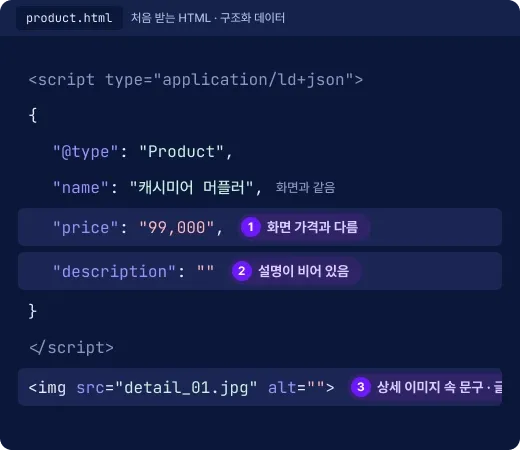
AI agents read your store's product, price, and stock information and answer on behalf of shoppers. When PLATEER checked for itself, what shoppers see on screen and what AI agents receive sometimes differed.
4Answers that it doesn't know the shipping fee or material
PLATEER internal check, October 2026
When AI misreads, shoppers remember your store as wrong.
Three Layers of Agentic Commerce
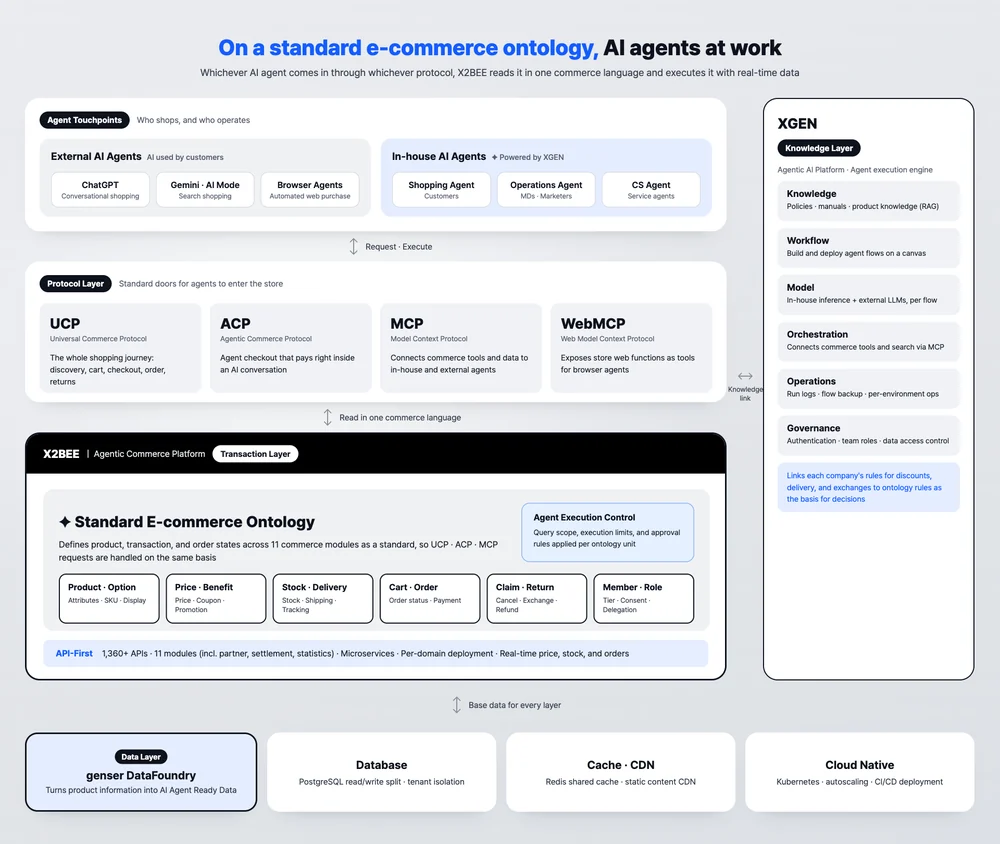
For accurate agent commerce: the data, knowledge, and transaction layers
For AI to buy and sell without mistakes, it needs three things
Connecting to AI is now a given. PLATEER builds the engine that lets AI agents know each client's prices, stock, benefits, and return rules precisely, and transact on them.
How is PLATEER preparing for agentic commerce?Learn more
Layer 01 · Data
Drawing on three sources
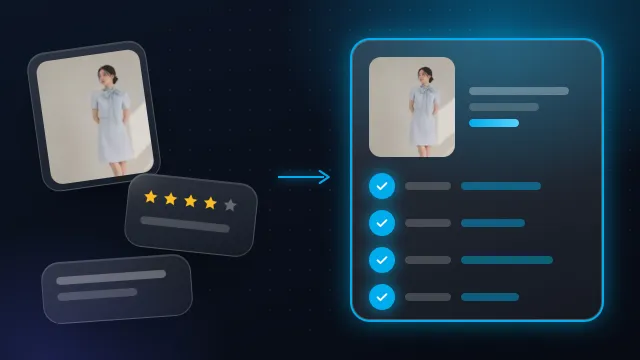
Much of the information on materials, ingredients, and specs exists only in detail images and reviews written for people.
Main images · product photosTurns what is visible into captions and attributes.
Detail description imagesReads seller copy with OCR and checks it character by character.
Purchase reviewsGathers buying experience, such as how sizes fit, thickness, and color, by product and option.
Multiple AI models cross-check the results, and items without enough evidence are held back rather than made up.
Layer 02 · Knowledge
Deciding by three principles
Values from the sourcePrices, stock, and order status are read in real time from the commerce system, not from copies.
Decisions by rulesDefined rules decide return eligibility and coupon use; AI helps with understanding and explanation.
Evidence with every answerEach answer shows which rules and criteria it was based on.
Layer 03 · Transaction
Agent transaction standards, step by step
UCPAn open specification covering product discovery, cart, checkout, and order management (co-developed by Google, Shopify, and others)
ACPA specification centered on merchant checkout and delegated payment (OpenAI · Stripe)
WebMCPA web API that lets AI agents call web page functions (W3C Community Group draft)
Under all three standards, the merchant remains the seller, and the merchant system's response is the final word on prices and stock. X2BEE applies these standard integrations step by step, starting with UCP and ACP.
The Engine for Agentic Commerce
The Engine for Agentic Commerce, across four stages of the customer journey
The right AI product for every shopping stage
Pick the products you need for each stage: getting found, helping shoppers find, selling, and running your store.
A solid commerce foundation, built with you from design to operation
20 years of designing and running online stores
We draw on our experience designing, building, and running large general and specialty malls to create online stores where AI does the work.
Commerce AX Engineering is PLATEER's foundation business: developing and running large-scale commerce, from general to specialty malls. From new builds on X2BEE to upgrades of clients' existing platforms, we draw on hands-on experience with product structures, transaction rules, and day-to-day operations to design agentic commerce from strategy through implementation.
01
E-commerce Design · Development · Operations
We design and build custom commerce platforms for enterprises and run them after launch.
02
X2BEE
An all-in-one, AI-Ready, customizable agentic commerce platform: the foundation for commerce where agents guide shoppers in conversation from product recommendations to checkout.
03
X2BEE AI Agent
Shopping, operations, and customer-service agents support customers, operators, and contact-center staff.
Products · DisplayOrders · PaymentDelivery · CS
X2BEE feature areas
Products · DisplayProduct and display management built for business growth
Standard and display category structures are kept separate, so operations stay stable as the catalog grows.
Manage multiple sites, and multiple malls within a site, from one account.
Build templates with Drag & Drop, then display products from those templates (by corner, store, and member group).
Supports many sales types, such as pre-orders, bundles, and free gifts, and manages required product disclosures to stay compliant.
Members · PromotionsMember management and promotions that lift conversion
Manage online and offline members in one place, including employees.
Membership tiers and tier benefits suited to each mall, plus Kakao, Naver, Apple, and Google social login, come standard.
Apply product, stackable, cart, and shipping coupons by product, brand, category, partner, or channel.
Even promotions with complex conditions, such as prize-draw and non-draw events, leave clean settlement data.
Orders · Payment · Delivery · CSOrder policies on par with large general malls, and one-stop customer service
Claims that customers file themselves in My Page are processed automatically.
Mileage and coupons are restored automatically on cancellations and returns, and stock-outs trigger automatic partial cancellation and customer notifications.
Pre-arranged Inicis and Toss payment gateways and Sweettracker delivery tracking are ready to use.
Integrated support handles 1:1 inquiries, product Q&A, and phone consultations in one place, with VOC classification.
Partners · Partner Office (PO)A PO system that widens your range and lightens your operating load
Approval-based partner product registration widens your range while keeping the mall consistent.
Partners handle sales, shipping, settlement, and inquiries themselves in the Partner Office.
Partners are rated on shipping compliance, order fulfillment, response time, and cooperation.
Manage contract information by affiliate and affiliate channel.
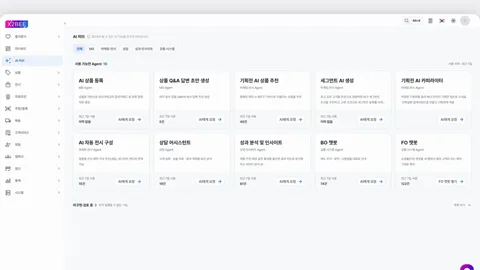
X2BEE AI Agents — Shopping · Operations · CS
X2BEE AI agents share the work: shopping for customers, operations for administrators, and responses for contact-center staff.
agent://shoppingonline
Shopping agent
Takes shoppers' questions, recommends products, and carries them through options, cart, and checkout. Summarizes reviews and product information.
agent://operationsonline
Lead agent · Hub
Operations agent
An AI operations chatbot in the admin console: ask about screens, policies, and operations data, and use AI features right on the screen you are working in. It is the hub that ties together the agents below.
Sub-agents directed by the operations agent
agent://productonline
Product agent
Creates required product disclosures, search keywords, and SEO copy from a product name, file, or URL, and flags where sources disagree, with citations. It also drafts answers to product Q&A and marks what needs checking.
agent://marketingonline
Marketing agent
Recommends products for promotions based on sales, reviews, and ratings, and builds customer segments from plain-language requests. Choose an industry and it recommends a display layout, applied straight to the editing screen.
agent://insightonline
Insight agent
Answers questions with charts and dashboards, and summarizes server status with causes and fixes.
agent://csonline
CS agent
Gives contact-center staff draft answers grounded in customer history and operating policy, and gathers support status on the admin console.
Composable Commerce
Commerce assembled from modules, with AI solutions plugging in the same way
An online store where you snap in the features you need, like building blocks. AI customer service and AI detail-page creation snap in as blocks too.
X2BEE is composable commerce that combines functions such as members, products, orders, payment, and settlement as modules. AI solutions such as customer service and detail-page creation are added the same way. All of them work on the same X2BEE member, product, and order data, and connect to your existing systems.
Blocks fit together on the same member, product, and order data · Dashed blocks are coming soon
X2BEE Nable AICC
From chat to phone support, connected to member and order data
AI answers chats and calls to the main number first, finds the member by name and phone number, and pulls up purchase history, delivery status and tracking numbers, payments, refunds, and whether a cancellation, exchange, or return is possible. When a conversation passes to a contact-center agent, they see the same member and order information right away, and support status is shown on the X2BEE admin statistics screen.
From one set of product information to detail pages and banners
Loads basic information by product code (ERP integration) or Excel, and adds required labels such as country of origin, nutrition facts, and size charts as modules in category templates. Admins add certification-mark and notice modules without any development, and banned words and missing required items are checked at the time of creation.
Only those who know the data structures and business logic can make agents actually execute.
1,086Clients
3,585Projects delivered
84.4%Engineers (% of staff)
PLATEER total, as of September 2026
Start with SaaS
Begin in weeks with SaaS, then scale to a full commerce foundation
Try it now, build it right
The stages where shoppers discover products in AI search and choose in your store start within weeks by integrating with your current store; the stages where AI agents handle orders, payments, and commerce operations are designed from the commerce foundation up.
Start light and fastAgentic commerce SaaS for your online storeKeep your current store · within weeks
ShopperShopping with AI
01 Discover
genser GEOYour products in AI answers
We enrich product information so generative AI cites your products as a source in its answers.
✦Source · your store
About 5 weeks on averageFree pre-check · 3 business days
02 Explore
genser DiscoveryAsk in sentences, get reasons
Takes situations and conditions as sentences and shows products with the reason for each pick.
🔍 A long coat for work
Typically 1–2 weeksTry it on gelatto
03 Buy
groobeePicks for every shopper
Segments shoppers with behavior data and shows each one the products and messages that fit.
1–2 weeks on averageCampaigns right after install
Foundation for every stage
genser DataFoundryProduct data AI understands
Turns information in detail images and reviews into product and option data, and updates it when products change.
Scoped by catalog sizePilot category first
→
Material · wool blendLength · longFit · oversizedReviews · warmStock by option
See preparation and deliverables by product
Challenge, preparation, deliverables, and timing for the four products you can start with right away
Product
Challenge
What you prepare
What you get
Rollout
Trial and pilot
genser GEO
Your products are not mentioned or cited in AI answers
Domain, product feed
AI comments, Q&A, meta descriptions, ALT text, JSON-LD; weekly measurement reports
About 5 weeks on average
Free pre-check (domain only, 7 areas, 3 business days)
genser Discovery
No-result searches; low accuracy for searches by condition or situation
Product feed (Naver EP, GMC) or product integration API
Widget, dedicated page, or API; intent analysis
Typically 1–2 weeks
Try it on gelatto; admin preview before launch
groobee
Every shopper sees the same pages and messages
Script or SDK installation
Personalized recommendations and messages; campaign performance analysis
1–2 weeks on average
On-site campaigns right after installation; basic recommendations after 2–3 days
genser DataFoundry
Product information sits only in detail images and reviews, out of reach for search and AI
Product feed, detail images, reviews
Structured product and option data; incremental updates
Scoped by catalog size
Pilot category processed first to check attribute coverage
To let AI agents handle orders, payments, and commerce operations
Build it rightDesigned and built from the commerce foundationFrom the commerce core · over several months
04 Transact
X2BEEStores where AI handles orders and payments
We design and build a commerce core with the source data and APIs for products, carts, orders, payments, claims, and delivery, made for AI. External AI agents come in through UCP and ACP (phased rollout).
Discover
Define/Design
Develop
Test&Deploy
Support
Pro about 6 monthsEnterprise about 8 months
05 Operate
XGEN · the base of X2BEE AI agentsAI agents that run commerce operations
X2BEE AI agents (shopping, operations, CS) are built, deployed, and controlled on XGEN, which manages what agents can do, approval steps, and execution logs under one standard.
Lotte Home Shopping · Marketing & MD AgentTrend and competitor insight reportsBroadcast product descriptions and CG plansAutomated display and scheduling
The same platform can extend to enterprise work such as finance and manufacturing.
These are real results from PLATEER clients. The clients measured the numbers themselves.
Case studies from clients that adopted PLATEER products and services, from online store design and build to AI exploration, AI search visibility, and agent operations. Figures are as measured by the customer.
20%↑
E-commerce · X2BEE AI
i-Scream Media: 20% sales growth after adopting X2BEE AI
We added AI services to an online store that keeps running even when crowds rush in. Sales and visits rose 20% the month after launch (measured by the customer).
Runs traffic reliably on an MSA-based architecture, with AI services added. After launch, sales, transaction value, and traffic rose 20% month over month (measured by the customer).
Automotive · Design, build, and operations
Hyundai Motor Company: a certified used car platform, from design and build to operations
We built the online store that sells Hyundai and Genesis certified used cars, and we still run it. We also handle a customer platform for the company's Japan subsidiary.
Designed and built the Hyundai · Genesis Certified Used Cars sales platform in 2022 and runs its operations. Also designed and built a new customer experience platform for the Japan subsidiary (J Platform), operated since 2022.
Home shopping · XGEN
Lotte Home Shopping: turning broadcast and e-commerce work AI-nativeAI agents help with broadcast and shopping work
AI helps plan on-air graphics, check broadcast schedules, analyze documents, screen risky products, and answer partners' questions. Personal data is hidden so it can be used safely.
Built XGEN-based AI agents for broadcast CG plan generation, schedule lookup and scheduling, document analysis, hazardous product checks, and a Partners Q&A chatbot. Personal data masking and guardrails keep operations safe.
Fashion · X2BEE
thehandsome.com: integrated mall redesigned and rebuilt on MSAintegrated mall redesigned and rebuilt from the ground up
We merged several brand stores into one, refreshed the screens, and added AI services.
Redesigned and rebuilt the integrated mall of thehandsome.com (Hyundai Department Store Group) on an MSA structure split by business function, upgraded the UI/UX, and integrated AI services.
Fashion · genser Discovery
SHOEMARKER PLUS: conversational AI discovery built in from day one
The new online store came with an AI shopping assistant from day one. The original search still works too.
genser Discovery was built into the fashion and shoe platform launched in August 2026 as a standard feature. It runs as a separate AI search channel alongside the existing search, narrowing candidates by following the context as shoppers describe their situation and conditions.
Food · genser GEO
CJ CheilJedang: product information turned into data AI reads and cites
We turned product information that existed only inside pictures into text AI can read. We also measure how often AI answers cite it.
Turns product information locked inside single long images into structured data AI can read, and runs it with source-based fact checks and AI citation measurement (CJ The Market).
Beverages · genser GEO
HiteJinro Beverage: image-heavy product pages turned into information AI can read
We turned product information inside pictures into text AI can read, and update it whenever the products change.
On its official mall, Jinro Tonic Mall, up to 40 attributes such as volume, pack size, and sales status were organized as structured data (JSON-LD) across 141 product detail pages, and alt text was added to 226 detail images. Since work began in August 2026, the content was updated 13 times through early October to reflect volume and bundle changes. Answers from three generative AI services are measured daily against 50 key questions and reported weekly.
Finance · XGEN
Jeju Bank · iM Capital: AI agents for finance in air-gapped networksfinance AI on internal servers cut off from the internet
To protect customer data, it was installed only on the company's own servers. Hiding personal data and filtering banned words keep it safe to use.
Installed on-premises in an air-gapped network to protect sensitive data, with security controls such as personal data masking, banned-word filters, and usage monitoring.
86%↑
genser Discovery CTR — after replacing existing AI search with genserProduct clicks rose after switching to an AI shopping assistant
Fashion company B, measured by the customer
6.5x
Purchase rate of sessions using genser Discovery — vs. sessions without searchShoppers who used the AI shopping assistant bought more than those who did not
Measured by genser Discovery clients
×3.4 · ×1.8
Citations of product detail pages, and citations as an AI answer source, after applying genser GEOHow often your product pages appear as sources in AI answers such as ChatGPT
Measured by genser GEO clients
2.2 · 2.7x
Clicks and orders from groobee AI recommendations — vs. statistical recommendationsClicks and orders after switching to AI personalized recommendations
Metrocity, mobile, January–March 2021, measured by the customer
FAQ
Frequently Asked Questions
What is agentic commerce?
Agentic commerce is commerce in which AI agents discover, transact, and operate. It is the third shift in commerce, after offline to online (1990s–2000s) and online to mobile (2010s), and it changes who makes the purchase: from people to AI agents.
What makes up PLATEER's Engine for Agentic Commerce?
It connects the four stages of the customer journey: genser GEO for awareness, genser Discovery for exploration, X2BEE for transaction, and XGEN for operations. groobee adds personalization across all stages, and genser DataFoundry provides the product data underneath every stage. You can try genser Discovery firsthand on gelatto, our B2C agentic shopping service.
What do AI agents need to transact accurately?
Three layers: data, knowledge, and transaction. Product information is turned into data AI can use (AI Agent Ready Data), product structures and transaction rules are defined in a standard commerce ontology, and transaction standards such as UCP, ACP, and WebMCP let AI agents know each client's prices, stock, benefits, and return rules precisely and transact on them.
Can it work with our existing online store?
Yes. Commerce AX Engineering covers both new builds on X2BEE and upgrades of clients' existing platforms. genser Discovery can be deployed as a widget, a dedicated page, or an API and runs alongside your existing search, and groobee needs only a script install, with no changes to your store, and goes live in one to two weeks on average.
How much commerce has PLATEER built, and which clients does it work with?
Since its founding in 2005, PLATEER has spent 20 years designing, developing, and operating large-scale commerce. We serve large e-commerce platforms such as Hyundai Department Store, LOTTE ON, Lotte Home Shopping, and Ellotte; card-company commerce for Shinhan Card, Lotte Card, and Samsung Card; and online sales for manufacturers and brands such as Hyundai Motor Company, Genesis, and Hankook Tire. On X2BEE, we have designed and built commerce for thehandsome.com (Hyundai Department Store Group), i-Scream Media, CJ Olive Young, and others, and in 2026 we won a contract to develop a large-scale e-commerce platform for Shinsegae I&C. As of September 2026, PLATEER works with 1,086 clients and has delivered 3,585 projects (company-wide).
What core technologies does PLATEER have for agentic commerce?
At the core is AX Foundry, a common engine that turns enterprise systems and knowledge into AI agents that do real work. AX Foundry works in three steps. Connect links existing systems and data such as ERP and CRM to AI (XGEN Multi-LLM and MCP integration); Structure turns unstructured data such as product information, images, and reviews into data AI can use (genser DataFoundry, Hybrid RAG and Ontology RAG); and Orchestrate builds and governs AI agents with no-code workflows (XGEN). On top of this come the standard commerce ontology, which defines product structures and transaction rules, and X2BEE, a commerce platform where agents can transact from order to settlement, with shopping, operations, and CS AI agents. As of September 2026, 82 R&D staff research these technologies, which are validated by 8 patents, GS Certification Grade 1 (XGEN and X2BEE), and CSAP certification.
How long does implementation take?
It depends on the product and how you start. With genser GEO, enter just your domain to get a free pre-check report within 3 business days; rollout takes about 5 weeks on average. genser Discovery goes live in 1–2 weeks as a widget, a dedicated page, or an API, and groobee runs within 1–2 weeks on average with just a script install. Designing and building a new online store on X2BEE typically takes about 6 months for Pro and about 8 months for Enterprise. If the client applies an X2BEE business template, it can go live within 3 months.
What results have clients seen?
After adopting X2BEE and X2BEE AI, i-Scream Media saw sales and transaction value rise 20% month over month, and traffic rise 20%. With genser Discovery, fashion company B saw CTR rise 86% after replacing its existing AI search, and at client sites, sessions that used Discovery had 6.5 times the purchase rate of sessions without search. With genser GEO, a food commerce client saw citations of its official site rise 1.6 times and citations of its product detail pages rise 2.1 times five weeks after adoption (measured by genser, June–July 2026). The i-Scream Media and genser Discovery figures are as measured by the customer.
Why should e-commerce companies choose PLATEER?
First20 years of hands-on experience designing, developing, and operating large-scale commerce, with 1,086 clients and 3,585 projects delivered.
SecondOne company offers everything agentic commerce needs: awareness (genser GEO), exploration (genser Discovery), transaction (X2BEE), operations (XGEN), and personalization (groobee).
ThirdYou can start step by step on the store you already run: platform design and development, operations and upgrades, expanding awareness and exploration with genser and groobee, and then scaling AI agents with XGEN.
FourthThe common engine AX Foundry lets us reuse the same technology, cutting project time from an average of 10 months to 2.5 months (based on internal projects).
FifthResults prove it: i-Scream Media grew sales and transaction value by 20% after adopting AI search, and a fashion mall that replaced its existing AI search with genser saw CTR rise 86%.
Agentic commerce: let's decide where to start, together
Leave an inquiry and our team will get back to you.
groobee is a subscription AI MarTech SaaS that automates personalized recommendations and targeting with real-time behavioral data. It segments customers, delivers the right message and products to each one, and measures performance to select what works best. Since its launch in 2016, it has run personalized marketing for e-commerce clients for 10 years.
The problem it solves
Showing every customer the same message and products lowers response and builds fatigue. groobee segments customers by attributes, behavior, and preferences and shows each one only the messages and products that fit. It identifies even non-member visitors, and with a single script install, marketers run campaigns themselves without development.
300+Clients to date (as of 2025)
28Recommendation algorithms, the most in the industry (as of 2025)
43.6BBehavioral data points (as of 2025)
Key features
Personalized targeting
Segment customers with 69 rule-segment variables and AI segments (RFM, purchase probability, and preference analysis). Target by sequence of actions, preview the expected audience for each combination, and select only customers whose segment has changed.
Personalized messaging
On site, show pop-ups, full-screen, floating bar, slide-in, and in-app messages at exit intent or at a specific scroll or click. Off site, send app push, KakaoTalk notifications, brand messages, and SMS, with recurring, behavior-triggered, and API-triggered sends and frequency caps to manage fatigue.
AI product recommendations
Recommend with 28 AI and statistical algorithms (as of 2025) that analyze the product being viewed together with customer history. Cover everything from frequently viewed together, visually similar, and next-to-view products to search-term and promotion recommendations, and find similar items for new products with no history from the product name alone.
Automatic optimization
Apply several algorithms to one recommendation slot, and AI calculates which best fits the goal (clicks or orders) and shows it first. Compare message variants with A/B/n testing, with reports that explain why AI selected each variant.
Analytics and monitoring
Get a real-time visitor dashboard, impressions, clicks, and order conversions by campaign, recommendation performance by algorithm, and funnel analysis from message receipt to visit and order.
Data integration
Install a script or SDK to collect behavioral data from your site automatically. Supports PC and mobile web, hybrid apps, and native apps, and connects hosted platforms such as Cafe24 and Godomall, custom-built stores, and your own data through APIs.
How it works
01Data collectionInstall a script or SDK, and visit, view, cart, and order data are collected in real time.
02SegmentationSelect campaign audiences with rule-based and AI segments.
03Personalized deliveryDeliver different content to each customer through on-site and off-site messages and AI product recommendations.
04Measurement and optimizationMeasure performance in real time, and prioritize what works best with A/B/n testing and automatic algorithm optimization.
Results
Metrocity
With AI and statistical recommendations applied together on product detail pages, AI recommendations delivered about 2.2 times the clicks, about 2.7 times the orders, and 2.3 times the conversion value (January–March 2021, mobile, measured by the customer).
Lotte Home Shopping
Reported sales up to 90% higher than the previous three months through segment-targeted campaigns (presented at a groobee meetup, November 2023).
Ambassador Hotel
A member campaign for room bookings tripled January room reservations compared with before the campaign (January 2021, customer case).
Getting started and support
Install a script with no changes to your store; most sites go live in one to two weeks on average. On-site campaigns work right after installation, basic recommendations after two to three days, and deep-learning recommendations become more accurate after about 14 days. After launch, the customer success team provides training, campaign reviews, and improvement proposals.
Certification and public sector
In November 2023, groobee became the first MarTech solution certified under CSAP (Korea's cloud security assurance program) and was designated an innovative product by the Public Procurement Service. In 2025 it was selected for the Global SaaS Marketplace (GSMP) program, and it has been used by ePost Shopping, Gongyoung Shopping, and the Korea Tourism Organization's digital marketing.
Clients
Lotte Home Shopping · CU · Shinhan Card · Jeju Air · THE HANDSOME · ePost Shopping · Gongyoung Shopping · MODERN HOUSE · BABADOTCOM and 300+ more
FAQ
How is groobee installed?
With a script, the same way as a Google Analytics tracking code. Your store's screens and features stay unchanged, and apps connect through an SDK.
How soon can we use it after installation?
Data collection starts right after installation, and with enough traffic most product data is collected within one to two days. On-site campaigns work immediately, basic recommendations after two to three days, and deep-learning recommendations become more accurate after about 14 days. Full operation takes one to two weeks on average.
Does it work with hosted platforms such as Cafe24 and Godomall?
Yes. Major e-commerce hosting services and custom-built stores both connect through scripts and APIs.
How is customer personal information handled?
Sign-up information and site activity data are collected and kept for up to three months in line with Korea's Personal Information Protection Act. Customers are notified that AI is involved in recommendations and personalization, in line with Korea's AI Basic Act.
genser GEO enriches the product information on your live site into content generative AI can understand and cite, then measures what changes in real AI answers and feeds the results into the next improvement.
The problem it solves
A product page that looks complete to people can look empty to AI. If AI cannot access the page, if key information exists only inside images, or if canonical URLs and structured data do not match, your products are unlikely to become sources in AI answers. genser GEO does not rebuild your site; it adds descriptions AI can read to the pages you already run.
Key features
Diagnosis and question design
Check robots.txt, initial HTML, canonical URLs, and structured data to see whether AI can access your site and read key information, then set the questions customers actually ask as the baseline for measuring results.
Text from images
Extract copy and features from product detail images with OCR and image analysis, and write only from the extracted information.
Content generation
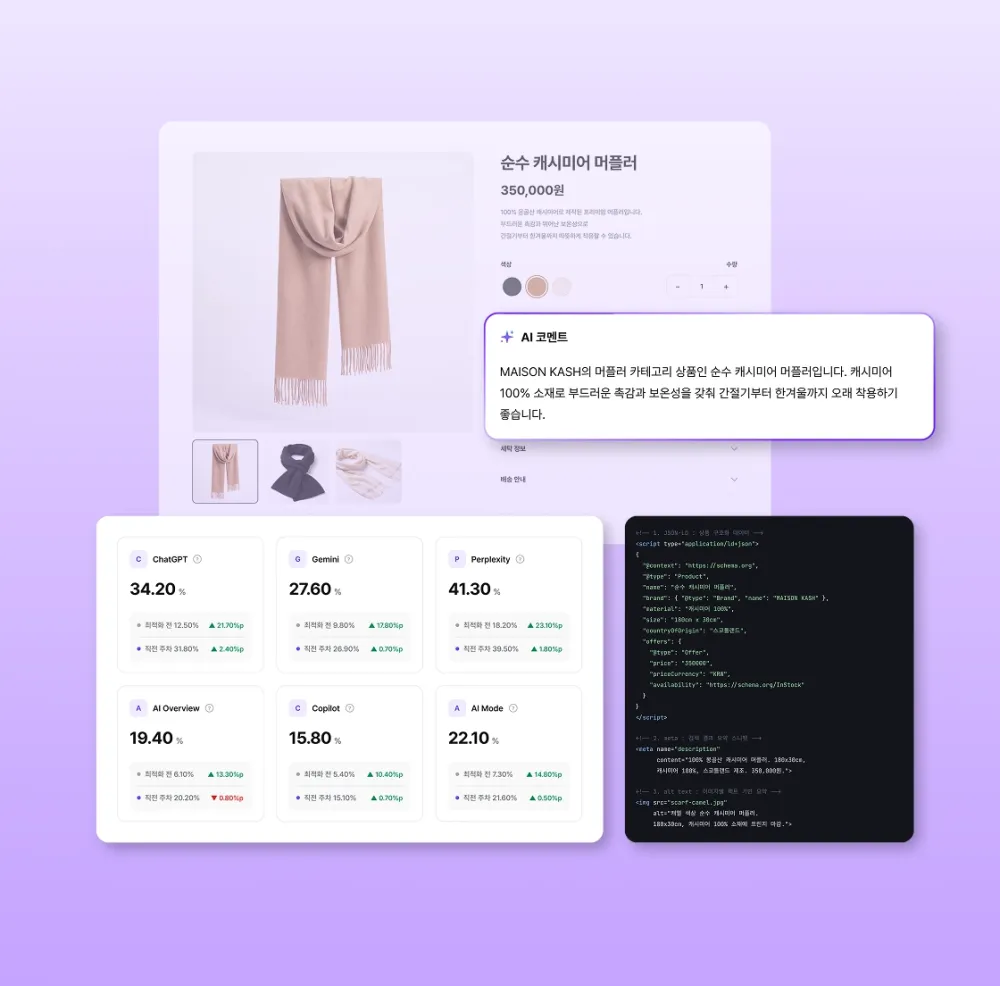
Put the same product facts into meta descriptions, image ALT text, JSON-LD, and AI comments (summary, features, usage context, Q&A).
Quality review
Check against the source to filter out unsupported facts and exaggeration, and deliver only content that has passed cross-review by multiple AI models and the client's final review.
Measurement and monitoring
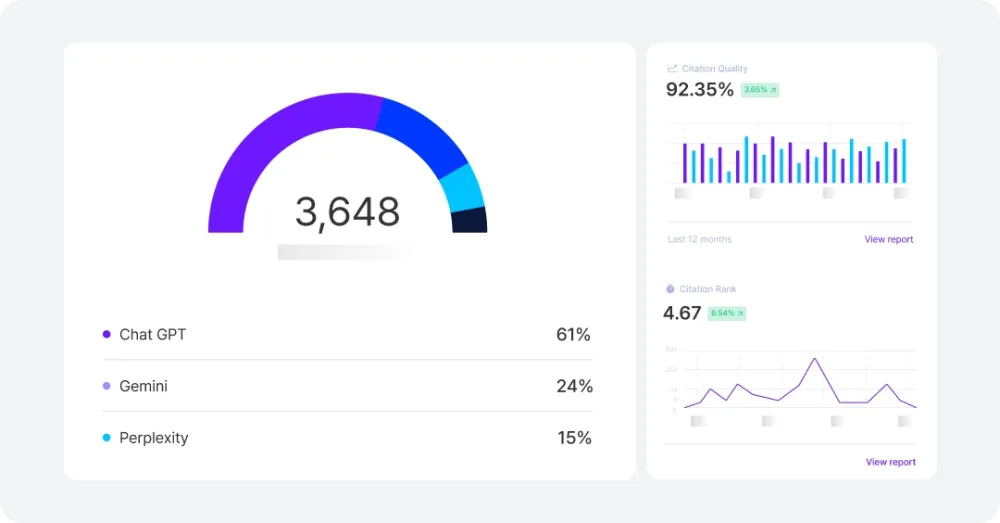
Ask ChatGPT, Gemini, Perplexity, Google AI Overviews, and Google AI Mode the same questions repeatedly to measure brand mention, recommendation, and citation rates. Engines and frequency are set by the scope of service.
Continuous improvement
Analyze frequently cited pages to form hypotheses, apply the adopted ones to the next content, and measure again with the same questions.
How it works
01Diagnosis and scopeUse the diagnosis to decide which pages to improve and which questions to measure.
02Baseline and content generationRecord answers and citations for the same questions before applying anything, then create and verify the content.
03Applying to your sitePLATEER delivers item-by-item guides and outputs; your team applies them to existing pages and shares the dates.
04Weekly comparison and improvementCompare how answers to the same questions change after weeks 1, 2, and 3, and propose the next improvements.
Product information is connected through Naver and Google Merchant Center product feeds, APIs, or Excel/CSV files. When products change, the related content is regenerated and verified.
Getting started
Enter your domain to receive a free GEO readiness report covering seven areas within three business days. Adoption takes about five weeks on average. Request a free GEO readiness report ↗
Clients
CJ CheilJedang · HiteJinro Beverage · Roger Nine (Golfnuts) and more
In use on brand-owned online stores in Korea, from food and beverage manufacturers to specialty brand malls, and also available in Japan.
FAQ
How is genser GEO different from traditional SEO?
Where SEO targets rankings and keywords in search results, genser GEO enriches product information with text and structured data so generative AI understands the facts and context of your products and cites them as sources. Results are measured not by rank but by mentions and citations in AI answers.
How do I know whether AI answers include our products?
We measure a baseline with fixed questions before adoption, then ask the same questions daily afterward and compare week by week. Results show whether your brand was only named or actually recommended, and whether the source was your official store or another marketplace. Weekly reports and the original answers are available in the admin console. A food commerce client saw citations of its official site rise 1.6 times and citations of its product detail pages rise 2.1 times five weeks after adoption (measured by genser, June–July 2026).
Do we need to rebuild our site?
No. We add meta descriptions, ALT text, JSON-LD, and AI comments to the product pages you already run. PLATEER provides item-by-item guides and your team applies them. Values that change often, such as prices, are not fixed in text but pulled directly from your store data.
Exploration · AI shopping agent for your online store
genser Discovery
genser Discovery is an AI shopping agent for your online store that understands what shoppers need and guides them to the right product through conversation. It keeps your current search as it is and opens one more channel where shoppers find products by talking.
86%↑Click-through rate (fashion retailer B, vs. previous AI search)
The problem it solves
Shoppers now describe their situation and conditions in full sentences, as they would to an AI, but most store search boxes are still built for a few keywords. If a product does not connect with what the shopper says, to that shopper it might as well not exist. genser Discovery turns those needs into a product choice.
ShoppersDescribe a vague goal or complex conditions, then choose from candidates shown with the reasons they fit.
Your storeKeep your existing search and user flow, and add an AI way to find products.
OperatorsLearn from conversations why shoppers search and how they choose, and put it to work in operations and marketing.
Key features
Recommendations that understand context
Takes sentences with context, preferences, and constraints as they are, and shows candidates together with why each one fits.
Narrow and widen through conversation
Remembers earlier conditions to narrow candidates, and widens from a product the shopper likes to similar styles, other price ranges, or other colors.
From one goal to several categories
Breaks a goal like "I want to start running" into shoes, apparel, and gear, and suggests what to look at first.
From guidance to requests
Answers from your shipping and exchange guides, and connects business systems through MCP to complete requests such as test-drive bookings within the conversation.
Search that reads images
Reads image-only product descriptions with OCR and extracts features from photos, so products once missed for lack of information can be found. Built on genser DataFoundry technology.
Intent analysis
Reads five signals from conversations and search terms — goal, context, selection criteria, trust cues, and emotion — and shows them in the admin console by signal, by context, and by click. It gives you grounds to improve promotions, product pages, and ads.
How it works
01Takes a sentenceTakes a sentence with context, such as "comfortable shoes for my commute," and decides what it needs to do to answer.
02Recommends with reasonsGoes beyond listing products and explains in words what it based each choice on.
03Narrows through conversationWhen the shopper adds conditions such as "something more formal" or "under 200,000 won," it rebuilds the results while remembering earlier conditions.
04Widens from a liked productExpands right away from a product the shopper likes to similar styles, other price ranges, or other colors.
05Links to the product pageClicking a product opens its detail page in your store. The purchase flow stays as it is.
When needed, it chooses its own tools among product search, customer service knowledge, web research, and business system connections. Web research is used only to understand the question; product facts come from your synced product information.
Getting started
Choose a widget, a dedicated page, or an API, and run it alongside your existing search. A dedicated page runs on your own domain with one CNAME record added to your DNS, and a widget opens as a window over your current screen without changing the layout. Products are synced through a Naver EP or Google Merchant Center feed or the genser product sync API, and you can check the screens in the admin preview before going live. Adoption usually takes one to two weeks.
Clients
SHOEMARKER PLUS · Hyundai Livart Mall · Celltrion Mall · SHOPLIST (Japan) and more
FAQ
Do we need to replace our current search?
No. genser Discovery leaves your existing search results and screens as they are and opens an additional conversational channel. Choose a widget, a dedicated page, or an API; adoption usually takes one to two weeks.
Does it answer based on our store's own policies?
Yes. It connects your guides, such as shipping and exchange policies, and answers within the scope of the registered materials. To handle requests and submissions, connect the relevant business system through MCP.
Where can we see analysis of shopper conversations and search terms?
In intent analysis in the admin console. See what shoppers look for, in what situation, and by what criteria, along with search terms that returned no results or no clicks, and use them to decide on promotions, product pages, and ad timing.
genser DataFoundry is a product data enrichment service that uses the product data, images, and reviews you already have as sources to build product- and variant-level data for search and AI agents (AI Agent Ready Data), and keeps it updated and supplied as products change.
The problem it solves
Shoppers ask by condition and use, such as "a long coat to wear to work." Yet most store product data is listing data — name, category, price, and options — while the answers, such as length, material, and feel, sit inside detail images and reviews. Without reshooting or rewriting anything, genser DataFoundry pulls out that information so search and AI can answer shoppers' conditions.
Key features
Category design
Defines, in a design sheet for each category that gets the same questions, which attributes to enrich and where to find them, and applies the same rules across the category.
Evidence-based extraction
Keeps seller wording, visible appearance, interpretation, and "cannot confirm" separate so facts and interpretation do not mix. Information not in the sources is never created.
Common and variant data
Separates information common to a product from variant information such as color and size, so answers can be given per variant.
Review synthesis
Combines scattered reviews into purchase experience by condition, such as size fit and feel. Information that could identify reviewers is left out.
Pre-delivery review
Multiple AI models cross-review and re-review to filter out information that differs from or overstates the source, and items without enough evidence are withheld.
Change-only updates
Only products with new listings, replaced images, or new reviews are reprocessed, hourly or daily.
Getting started
You do not have to hand over your whole catalog at first. We start with part of a target category to see how many designed attributes get filled and which ones cannot be confirmed, set the processing rules on that pilot category, and then expand to the full catalog. Product information comes in through Naver EP or GMC feeds, a product sync API, bulk files, or designated storage, and results are delivered as product- and variant-level structured data by file, lookup API, or designated storage.
Measuring results
Data quality is reported from processing results: attribute fill rate, attributes added per source, review results, and update status. Business results, such as zero-result search rate, feed visibility, and mentions and citations in AI answers, are compared before and after under the same conditions together with the client.
FAQ
How is it different from genser GEO and Discovery?
genser Discovery is an AI agent for product discovery in your online store, and genser GEO is a service for being cited in external AI answers; each includes the product data enrichment it needs and can be used on its own. genser DataFoundry processes a wider range of product information and turns it into a data asset you can use wherever you need. Connect once, and genser products share the same product data.
Does it create information that is not in the sources?
No. Specifications that cannot be confirmed from the sources are recorded as "cannot confirm," and values without enough evidence are withheld. Seller wording is stored exactly as written.
Does it handle orders and payments?
No. genser DataFoundry covers preparing product information so AI and search can understand and look up products.
An agentic shopping service where consumers experience genser technology firsthand. Tell it what you want on the web or in the app, and it finds matching products.
Apr 2026Launched in Korea and Japan
1.5M+Connected product SKUs (June 2026)
Web · AppAndroid and iOS
Key features
Conversational discovery
Describe your situation and conditions, and it finds and compares matching products.
Korea and Japan
Available in both countries at gelatto.ai and gelatto.jp.
Experience genser
Also serves as the hands-on demo of genser Discovery.
An AI-Ready, customizable agentic commerce platform. It powers commerce for mid-to-large enterprises by combining modules for membership, catalog, orders, payments, and settlement.
11Modules
167Menu items
Grade 1GS Certification (KTL, January 2023)
Key features
Composable modules
Combine shared modules built on a MACH architecture to compose and extend storefront, back-office, and supplier-portal screens. Features are exposed through about 1,360 APIs (about 360 storefront and 1,000 back-office, as of November 2026).
Commerce AI agents
Shopping, operations, and customer-service agents support customers, operators, and contact-center staff.
Multilingual and multi-site
Supports Korean, English, and Japanese, multiple domains and sites, and B2B accounts.
Integration
Connects payment, tax invoicing, order collection, and legacy and ERP systems.
X2BEE is an all-in-one, AI-native, customizable commerce solution.
01 Operations Agent Agents grouped by task, on one screen. The AI Hub screen gathers admin AI features in one place.
02 Product Agent Enter just a product name, URL, or image: AI fills in required info, keywords, and SEO copy. Ask the AI chatbot to add a product, and AI organizes the fields to fill in. Confirmed details are filled in on the product registration screen.
03 CS Agent AI drafts answers to product Q&A and flags the parts to double-check. Review the draft right in the product Q&A management screen. CS assistant: review, don't search. It drafts replies based on operating policies, and CS staff review the AI draft before replying.
04 Marketing Agent Promotion intros in different tones (conservative, emotional, or sales). Select a promotion, and AI drafts its introduction. AI picks products that fit the promotion, based on its theme and copy. Review the recommended products and select the ones you need. Display layouts recommended by industry, straight to the canvas with no development. Pick an industry for a suggested layout and apply it straight to the canvas.
05 Insight Agent From one question to a chart. Ask about sales, member, and order stats. Ask for "Top 5 best sellers as a pie chart" and the answer comes as a chart and table. Ops chatbot for screen and policy help. Ask where a menu is, and the chatbot shows you the way.
06 MACH Architecture Every feature via API: about 1,360 APIs (front ~360, back office ~1,000).
07 Headless · Modular Swap only needed modules and scale with traffic. Per-module deploys with Auto Scaling.
X2BEE is an all-in-one, AI-native, customizable commerce solution. Start from a blank promotion page. Drop in a template to add the header and footer at once. From the block list, drag a Hero banner into the body. Enter a title and description, then upload a banner image, and it appears on the canvas right away. Drag a product section in from Groups, then pick products registered in the back office (BO). Section titles can be edited in place. The Structure tab shows the blocks under the header, body, and footer as a tree. Check the mobile view with the same layout right away. Click Display Now, and the page goes live without help from developers. It appears as is on the storefront (FO) promotion page.
X2BEE is an all-in-one, AI-native, customizable commerce solution. Build home and category screens in the back office (BO). Register a layout, name it, and set its location. Drag display sections from the left to build the screen. Sections that load data automatically, such as rankings and reviews, can be placed wherever you want. Click a section to edit its dates and content on the right. Save a draft, and the screen layout is stored as JSON data. No development request, no deployment. Click Preview: the storefront (FO) reads the saved JSON and draws the actual page. Check the mobile screen right away with the same JSON. Next, review the pre-publish check results and choose to display now or schedule it. Confirm the target and display location, then select Display Now.
Delivery
Available in Pro and Enterprise plans, both including source code.
Clients
THE HANDSOME · CJ Olive Young · Genesis Europe · Lotte Card · Osstem Implant and many more
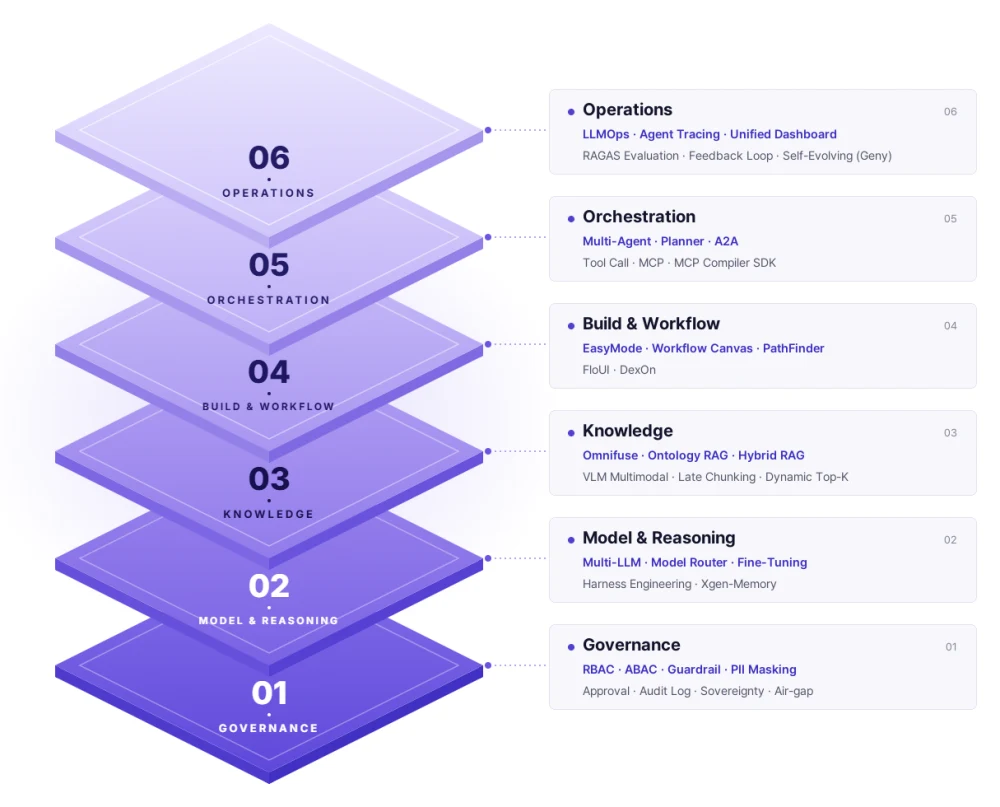
An agentic AI platform that lets enterprises build, deploy, and govern their own AI agents, and that evolves on its own the more it runs. It handles real work from commerce operations to finance and the public sector, on-premises (including air-gapped), in the cloud, or hybrid. Before deployment, risk is assessed and approved through a sign-off chain, and execution runs in an isolated environment.
Grade 1GS Certification (TTA, July 2026)
11Patents and certifications (AI Labs, October 2026)
Key features
01 Control and governance
Manage access (RBAC, ABAC), PII and banned-word controls, and audit logs; AI services are risk-rated and deployed only after sign-off through an approval chain. Agent reasoning is separated from code execution, which runs in an isolated environment with credentials kept outside it, and installing on-premises or air-gapped keeps data inside your organization.
02 Self-evolving
In the Geny runtime, agents pick up the context and outputs of earlier work and build the tools they need when none exist. They review execution results and fix nodes, tools, models, and their way of working on their own, so performance improves the more you use it (Geny, Xgen-Memory).
03 Connect enterprise knowledge
Finds grounded answers in internal documents and data with Omnifuse and Ontology RAG.
04 Build agents
Build agents in chat (EasyMode, DexOn) or on a canvas (Workflow Canvas), and turn existing web systems into tools with PathFinder. Deploy agents by sharing with colleagues, embedding on the web, or scheduling runs; apps built in chat go live after administrator approval.
05 Connect to everyday workflows
Connect to internal systems through MCP and APIs, and let multiple agents split roles and collaborate. Agents on the server carry work through to users’ PCs (DexOn).
06 Operations and observability
Track and improve execution, tokens, and quality with dashboards and Agent Tracing, and stop anything abnormal at once with a kill switch.
How it works
01BuildBuild agents in chat or on a canvas, and business apps in chat.
02Review and approveAssign an approval chain by risk level for review, and deploy after approval by the system administrator and the governance owner.
03Run in isolationSeparate reasoning from execution, and keep credentials outside the execution environment.
04Record and stopRecord every run in audit logs and Agent Tracing, and stop anything abnormal at once with a kill switch.
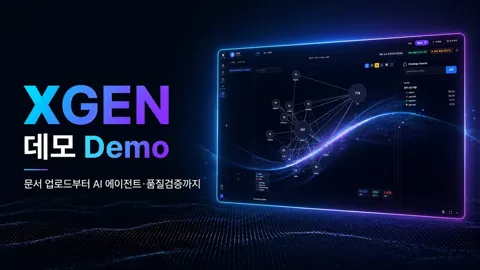
AI knowledge store From document upload to knowledge graph. Log in to XGEN: Agent Studio. Knowledge Management: knowledge collections. New collection. Collection details: 'x2bee_서비스정책'. Created: open the empty collection. Folder upload: 11 policy documents. Upload all 11 documents at once and track each file. Upload complete: automatic chunking and vector indexing (416 chunks). Collection registered: 11 documents. Ontology menu: choose what to build. Not yet built: 'x2bee_서비스정책'. Ontology build: extracting schema and instances (concepts, relations, entities). Pre-built knowledge graph, same 11 docs (19,471 triples, 209 classes).
Semantic search Meaning-based knowledge discovery. Natural-language question: graph-based search. Graph search: related knowledge nodes are highlighted and evidence triples collected. Structured answer: uses 200 evidence triples, grouped by type of responsibility.
Source: scanned card receipt (image only). Knowledge Management: create a collection for evidence. Enter collection details: 'evidence_증빙전표함' (receipts). Created: open the collection. Attach the scanned evidence (PDF). Turn on OCR to recognize text in scanned documents. Upload: automatic processing and indexing. Evidence registered. Check the registered document: open the receipt. Text conversion and indexing: every field on the receipt is now searchable text. Canvas: assemble a review agent. Add a retrieval node to connect the evidence collection. Place nodes by dragging. Connect ports: evidence search → agent. AI engine: sLLM. Search settings: evidence collection 'evidence_증빙전표함' (receipts). Run now: search → agent. Review query: merchant, approval no., amount, document no. Auto-extracted: receipt fields and approval doc no. verified, sources cited. Image → text → automatic extraction and check.
Conversational AI chatbot From no-code assembly to answers. Canvas: the no-code agent builder. One click creates an agent node. Search the node catalog and add a 'RAG retrieval' node. Arrange nodes by dragging. Connect ports: search results → agent references. Choose the AI engine: sLLM. Search mode: Ontology Search (knowledge graph) + collection x2bee. Run now: search node, then agent, in order. Ask the finished chatbot: when can an order be canceled? An answer grounded in the knowledge graph: 90 seconds from assembly to run, no coding.
AI quality evaluation Batch tests, LLM Judge scoring. Agent Builder: quality evaluation (batch tests, history, metrics). Create a new test. Upload test set: questions and answers (CSV). Target: the new Agentflow. Test starts: 5 questions run together in the background. Run complete: 5/5 (COMPLETED 100%). LLM Judge scorecard: SUCCESS on every question, 92–100 points.
XGEN PathFinder The easiest way to connect AI to legacy systems. Log in to a legacy system with its own authentication. Just click through the menus, and the APIs are collected automatically. Check the collected APIs in the XGEN browser plug-in. Check the APIs registered automatically in XGEN. One line in natural language → tool chosen automatically → live API call. Just like a conversation: AI makes the calls and answers.
Agent Studio Full feature demo. Builder → Canvas → Tools → Knowledge → Chat → Teams. Agent Studio home: menus for every step, from planning to chat.
Agent Builder ① Planning and design. Task Planning: manage agent development plans in a list. Plan details: step by step, from basics to process analysis and benefits. Agent Design: from goal to how you start. Three ways to start: chat, template, or blank canvas.
Canvas ① Build it yourself on a blank canvas. Click 'Start with a blank canvas' to begin designing right away. Blank canvas: the agent start button creates the first node. Agent node created; add start and end nodes. Start node: add the user's question as input. End node: add the AI answer as output. Drag to connect ports: question input → agent. Then connect the agent's stream to the output. Set the AI engine and model on the agent node. Enter a question in the start node and run it. The new flow runs, with execution order and logs shown in real time. Run complete: the agent you built has generated an answer.
Agent Builder ② List, operations, quality, prompts. Agent list: manage agentflows and run them directly. Agent operations: register a schedule to run automatically at set times. Agent quality evaluation: test a saved agent with questions and answers. Upload a dataset of questions and expected answers. Choose the agentflow to evaluate. With AI evaluation, an LLM scores the outputs. Test starts: the agent answers each question. Batch test running: progress is shown on the card. While waiting, look at the quality metrics tab. Evaluation criteria such as safety and accuracy are kept as presets. Back to the test list to confirm it's done. Test complete: check the results. Compare questions, expected answers, and the agent's actual output side by side. Agent prompts: store and share prompt templates. Manage text, language, type (User/System), visibility.
Canvas ② Open and reuse an existing flow. The Edit button in the agent list opens the canvas directly. A flow with knowledge search answers from documents. Enter a question in the start node and run it right on the canvas. Agentflow run: execution order and logs appear in real time. Run complete: check the final answer and each node's log. Open a saved agentflow and keep working. Save the finished flow and deploy it as a service.
Tool Integration API tools and auth profiles. API tools: register a REST API as a tool the agent can call. Tool test: call a registered API right away to check it works. Auth profiles: manage and share API credentials as profiles.
Knowledge Management Collections, ontology, storage. Knowledge collections: a knowledge store that keeps work documents as collections. Create a collection: set the embedding model and keyword/full-text search options. Uploaded documents are chunked, embedded, and stored as vectors. Upload history: track each file's status, chunk count, and processing time. Glossary: register domain terms to improve search quality. Ontology graph: visualizes knowledge triples loaded into the graph DB. Ontology search: answers questions based on evidence in the graph. File storage: upload, keep, and share files. DB integration: use databases as knowledge and tools. Connection test: check a registered database connection instantly.
Agent Chat Run agents by conversation. Start a chat: pick an agentflow and start talking right away. Ask, and it answers from the collection. Generating: knowledge search and generation continue. Answer complete: the referenced documents are shown as sources. Chat history: every conversation is kept.
Teams Collaborative chat for people and agents. Teams: people and AI agents in one chat room. New chat room: invite people and agents to start collaborating. Pick an agentflow and invite it as a chat room member. @mention an agent in the chat room to ask it a question. The agent answers right in the chat room. XGEN Agent Studio: plan → design → tools and knowledge → run and collaborate.
Say it, and it becomes an app: backend, screens, and data from one request.
XGEN DexOn: describe the app you want in words. Just write what you need, down to the data and screen layout. This one request is all it takes.
The agent makes a plan and builds the app's skeleton first. Switch to IDE view to watch the files and code being filled in. It writes the backend and screens, runs them, and fixes problems on its own.
The actual time taken: 8 minutes 39 seconds. When it's done, it reports what it built and what it checked. Every step of the work is recorded.
The app opens right there. Sales, order count, hourly trends, even category share. It's a real app: the numbers change with every new order. A regional ranking, live order feed, and searchable table were built too.
Ask for changes in words. We asked for dark mode and low-stock alerts. The agent edits the code and redeploys it, too. Refresh the app, and the updated screen appears.
Dark mode is in, and the low-stock alerts update with each order. Click Share to send it to your team with one link. You can switch models even mid-conversation.
XGEN, the agentic AI platform for enterprise AX innovation.
Finance cases
In-house generative AI platform at Jeju Bank (in operation), AI platform for iM Capital (contract signed, 2026)
Clients
Jeju Bank · iM Capital · Lotte Home Shopping and more
FAQ
How does XGEN keep agents from doing anything risky?
Before deployment, an approval chain of the collaborating team, governance, and information security is assigned and reviews each service by risk level. In operation, lookups and drafts run automatically, reversible actions run after approval, and irreversible actions are carried out by a person after sign-off.
If an agent is fooled by prompt injection, can credentials leak?
XGEN separates reasoning (Harness) from code execution (Sandbox) and keeps no long-lived credentials such as API keys or OAuth tokens in the agent or its execution environment. When an external connection is needed, credentials are passed only after the user's delegated permission and the agent's identity are verified.
Is Geny a separate product?
No. Geny is the runtime inside XGEN that shapes how agents work, and building agents on the existing canvas stays the same.
genser DataFoundry is a core PLATEER technology. It is the foundation of genser GEO and genser Discovery.
AI agents can only do their job when product information is in place first. Yet much of it, such as materials, ingredients, and specifications, lives only in detail images and reviews written for people. genser DataFoundry extracts, structures, and verifies this information into product- and option-level data that search and AI agents can use right away, and updates it as products change.
Three sources
Main images · product photos
Turns visible features such as logo placement, neckline, cuffs, and hem into captions and attributes.
Product detail images
Reads seller text in images (materials, ingredients, specifications, shelf life) with OCR and checks it character by character.
Customer reviews
Summarizes purchase experience such as size fit, thickness, and color payoff by skin tone, per product and variant.
How it works
01DesignOrganizes shoppers' use cases and selection criteria by category, and decides which attributes to enrich and from which sources.
02ExtractPulls seller wording and spec tables from detail images, appearance from photos, and purchase experience from reviews. Existing product data is checked first so only newly found information is added.
03StructureStores seller wording, appearance, interpretation, and "cannot confirm" separately, and separates common information from variant information.
04ReviewMultiple AI models cross-review and re-review. Numbers and units are accepted only on an exact match with the source; anything that differs from the source or lacks evidence is withheld.
05UpdateOnly new and changed products are reprocessed, with processing time and change history recorded, and products no longer on sale are dropped from the supply.
Example · beauty product (blush)
Texture · finish
Wet baked · subtle shimmer
Formula claims
Clean vegan · talc-free (seller claim)
Options
Color description and full ingredient list for each of the 6 shades
Shelf life
36 months from manufacture / 12 months after opening
Used for searches and questions likevegan blush · shimmery cool-tone blush · ingredients by shade
Seller claims are stored as stated and never turned into certified or verified values.
Where it is used
Client product DB and searchgenser Discoverygenser GEO content (AI product summary · Q&A · JSON-LD)External shopping feeds (by agreement)External AI agent channels (by agreement)
Integration · updates
Connects through product feeds (Naver EP · Google Merchant Center), a product sync API, bulk files, or designated storage. Processing runs on a schedule rather than in real time, reprocessing only changed products hourly or daily; if updates are frequent, the product sync API is recommended.
An ontology is a knowledge system that defines commerce concepts such as products, orders, claims, and coupons, along with their relationships, states, and transaction rules, in a form AI can understand. PLATEER is codifying 20 years of commerce operations into a standard ontology for X2BEE and XGEN. Instead of building from scratch for each client, we add only the client's own rules on top of the standard.
Three principles
Values from the source
Prices, stock, and order status are read in real time from the commerce system, not from copied values.
Decisions by rules
Defined rules decide questions such as return eligibility or coupon use; AI helps understand the question and explain the answer.
Evidence with every answer
Each answer shows which rules and criteria it was based on.
Roadmap
01ProveStart with orders and claims, where rules are densest, and measure transaction accuracy.
02ProductizeBuild the standard ontology into X2BEE and XGEN and apply it to clients.
03Expand by industryExtend to fashion, food, B2B, and other industries to set the standard for agentic commerce.
We apply the standard ontology to clients in phases through the X2BEE and XGEN products.
As AI agents search, add to cart, and check out on behalf of customers, transaction accuracy depends on the seller's system. PLATEER builds commerce that reads prices, stock, and orders directly from the source, controls agent actions under permissions and approvals, and lets external AI agents come in through open standards.
Related products
X2BEE · where transactions happen
An AI-Ready, customizable agentic commerce platform that holds the source data and APIs for products, carts, orders, payments, claims, and delivery.
XGEN · control over agent actions
A platform to develop, deploy, and control AI agents. It manages what agents can do, approval steps, and execution records under one standard.
Agent commerce standards Phased adoption
UCP (Universal Commerce Protocol)
An open specification covering product discovery, carts, checkout, and order management, co-developed by Google, Shopify, and others.
ACP (Agentic Commerce Protocol)
A specification maintained by OpenAI and Stripe, centered on merchant checkout and delegated payment.
WebMCP
A web API that lets a web page register its functions as tools that AI agents can call directly (W3C Community Group draft).
Shared principle
In all three standards, the seller remains the merchant of record, and the seller system's response is the final reference for price and stock. That is why accurate source data in X2BEE and execution control in XGEN form the foundation of agent transactions.
X2BEE adopts these standards in phases, starting with UCP and ACP.




































 20%↑






 2:10
 1:06
 1:04
 5:01
 6:44
 1:53