2026-01-09

What is your workplace like? Have you ever requested server permissions for a new project only to get stuck because you don't know which department handles it? Or submitted an urgent approval request for troubleshooting, only to have work stall while waiting endlessly for the approver's signature?
While many companies are expanding benefits to attract talent, employees often grow weary from the countless small and large inconveniences in their daily work. This is where we must focus on the keyword ‘Employee Experience (EX)’.
Employee Experience refers to the sum total of all interactions and emotions an employee experiences throughout their journey with an organization, from joining to leaving. According to McKinsey research, employees with positive EX demonstrate up to 16 times higher engagement and 8 times greater likelihood of staying compared to those without. This directly translates to enhanced corporate productivity and maximized employee performance. ⃰
Why should we focus on ‘employee experience’ now? 🤔
The importance of employee experience has been highlighted due to a combination of internal and external factors.
✅Internal cultural shift: As Millennials (born 1981–1996) became the backbone of organizations, the existing performance-centric paradigm reached its limits. Companies must now secure future competitiveness by establishing rational procedures and efficient systems within work processes.
✅External Environmental Changes: Beyond digital transformation (DX), the acceleration of artificial intelligence transformation (AX) has shifted all work to intelligent IT infrastructure. Furthermore, increased labor market flexibility has made creating a desirable work environment essential for attracting top talent.
Despite these demands of the times, the pace of change employees actually experience in the field remains painfully slow. While many companies are making various attempts to secure talent, the ‘Digital Friction’ that disrupts smooth workflows remains unresolved. Employees grow increasingly weary due to barriers like technology silos, complex approval processes, and data fragmentation. Improving the employee experience begins with eliminating inefficient processes that cause bottlenecks in work.
🗃️Technical Silos and Context Switching
While DX and AX have introduced various work tools, information fragmentation has actually worsened. The ‘Context Switching’ required to switch between 5-6 tools to complete a single task distracts employees and causes fatigue. Experiences where information context is lost due to barriers between tools create the side effect of technology silos: reduced employee work efficacy and hindered communication within the organization.
🗃️Complex Approval Workflows and Delays
For members seeking rational processes, operational delays caused by failing to immediately update approval systems during organizational changes, or approvals stalling due to absent personnel, represent an incomprehensible ‘waste’. Particularly, opaque systems where one cannot easily grasp their approval/rejection status at a glance lead to work leakage. The management effort required when organizational changes aren't immediately reflected in systems ultimately generates unnecessary maintenance costs and hinders employee focus.
🗃️Data Fragmentation and Rigid Workflows
Traditional ITSM solutions introduced to solve problems also hit another wall. Data silos stemming from unintegrated, dispersed DevOps toolchain information within the company, coupled with processes ill-suited to the domestic corporate environment, make adherence to standard guidelines (ITIL) difficult. The experience of being forced to follow systems that cannot respond flexibly to change wastes the resources of highly skilled technicians, ultimately creating a vicious cycle that hinders the business agility of the entire company.
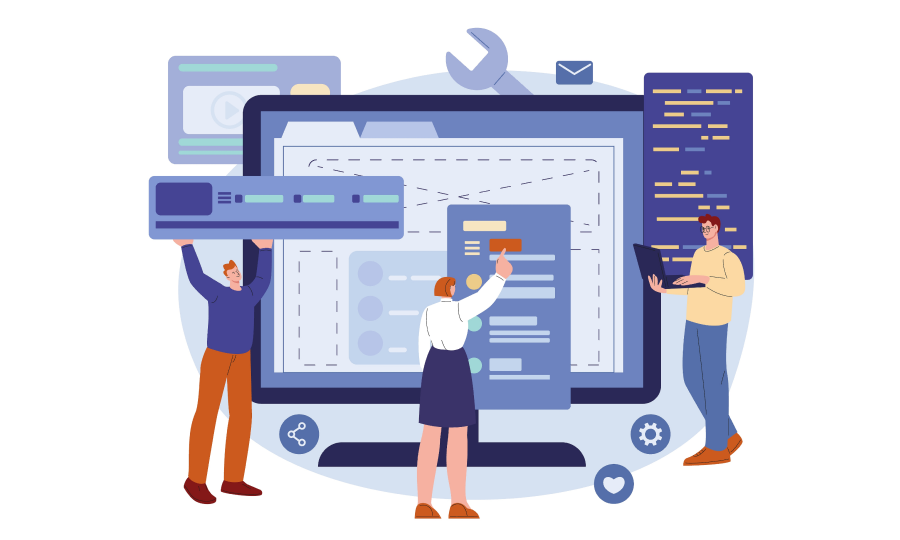
So what choices should companies make to address these structural issues? Rather than leaving employee experience to individual adaptation, solutions that can be designed and managed at the system level are needed.
(Provided by PLATEER, Image Source: Clipart Korea)
To break down the three barriers mentioned earlier and design a positive employee experience, PLATEER proposes the ITSM solution ‘Matilda’. Matilda combines a global standard platform ⃰ ⃰ with technical flexibility optimized for the domestic business environment.
Specifically, Matilda ensures stability through proven workflow implementation and dramatically reduces implementation time and costs by minimizing unnecessary configuration discussions during deployment. It also delivers significant business value by substantially cutting future maintenance costs through the reduction of redundant code.
|
⃰ ⃰ Matilda operates on the Atlassian JSM (Jira Service Management) platform, a globally recognized ITSM tool. Existing Jira users can set it up quickly, and its similar interface makes it easy to use.
|
1. Providing ITSM Standard Processes: The Starting Point for Enhancing Work Effectiveness
Matilda enables employees to focus on core tasks without getting bogged down in complex procedures through standardized guides.
⚡ITIL Compliance: Continuous efforts and diverse templates for ITSM and ITIL compliance reduce employees' psychological burden.
⚡User-Friendly Environment: An intuitive user interface provides an experience where anyone can start work easily and quickly.
⚡Domestic Environment Optimization: IT service request types optimized for the domestic environment enhance efficiency by allowing practitioners to work in familiar ways.
2. DevOps Toolchain Information Management: Creating a Seamless Immersive Environment
Connects fragmented information into one cohesive view, dramatically reducing fatigue from switching between tools.
⚡Integrated Management Dashboard: Provides linked information management and metrics for an enterprise's distributed DevOps toolchain. Maintains work context by enabling convenient management from a single dashboard.
⚡Cross-Team Connectivity Support: Facilitates connections between development and operations teams. Enables user and permission management for Jenkins, Bitbucket, and GitLab, reducing collaboration friction.
⚡Resource and Information Mapping: Resolves data fragmentation issues through project and repository creation, as well as DevOps toolchain information mapping.
3. Approval Automation: Empowered Decision-Making and Swift Task Execution
Transforms rigid approval processes into flexible automation, accelerating perceived decision-making speed for employees.
⚡Ensures Information Flow: Guarantees information flow between teams for sound decision-making, eliminating unnecessary wait times.
⚡Flexible Approval Features: Provides approval, consensus, and reference functions through designated approval lines. Ensures uninterrupted workflow even when responsible parties are absent via approval line registration management and alternate approver designation.
⚡Real-Time Approval Processing: Enables immediate approval after reviewing personal approval information and history on the dashboard, supporting proactive task management by practitioners.
4. ITSM Dashboard: Performance Verification and Insight Generation Through Visibility
Intuitively visualizes data, enabling employees to clearly grasp work status and performance while gaining diverse insights.
⚡Data-Driven Insights and Planning: Provides various statistical charts for IT services (e.g., delayed cases by type), allowing at-a-glance monitoring of operational metrics and facilitating work planning.
⚡Proactive Risk Management and Immediate Response: Identify potential risks early on the dashboard and resolve issues instantly with a single click, enhancing operational stability.
⚡Integrated History Management and Transparency: Centralize access to histories of IT services, approvals, DevOps configurations, etc., reducing information search time and fostering a transparent communication-based work culture.
The key to maintaining competitiveness ultimately lies in optimizing the employee experience. True digital transformation cannot be achieved while leaving fragmented tools and rigid processes unaddressed. Companies must actively leverage powerful ITSM solutions that enable employees to focus on core value, and PLATEER presents ‘Matilda’ as the solution.
(Provided by PLATEER)
'Matilda' breaks down technology silos to foster immersion, flexibly manages approval workflows, and eliminates digital friction at every stage—from implementation to maintenance—through proven processes.
With flexibility tailored specifically to the domestic corporate environment, it promises tangible business results beyond mere system implementation. In practice, adopting the ‘Matilda’ solution can reduce ITSM implementation costs by at least 30% and achieve over 200% faster deployment speed. Furthermore, operational costs post-implementation can also be expected to decrease by 20%.
In this way, ‘Matilda’ provides an environment where employees can immerse themselves in creative and strategic work. This innovation in experience directly translates into business agility for the company, becoming the most reliable driver for maximizing performance in the AX era. Especially for companies experiencing rapid growth or facing operational bottlenecks due to complex IT environments, ‘Matilda’ can be an immediate solution.
[Learn More About the 'Matilda' Solution] → Click
* Source
This time it’s personal: Shaping the ‘new possible’ through employee experience
Did you like today's content?
Subscribe to the PLATEER newsletter!
We'll send you curated content from PLATEER right to your inbox.
20.jpg)


