2025-12-19

Spotify's ‘Wrapped Year-End Review’ goes beyond a simple report, offering a powerful personalized experience that defines ‘me’ through data.
What insights should our company gain from this campaign, eagerly awaited worldwide each year?
[View the Full Series👀]
① Why do we anticipate ‘our own records’ at year's end? (→ We are here now!)
② How to build a brand that knows you better than you know yourself
Every December, a campaign heats up social media: Spotify Wrapped, the global music streaming platform's annual feature!
The Wrapped campaign is a personalized year-end summary report. It presents Spotify users' most-played songs, favorite artists, preferred genres, and total listening time through interactive content like visual infographics and witty captions. It doesn't just provide dry statistics like ‘total hours of music listened to.’ Instead, it defines the user's musical identity by delivering phrases like ‘You're in the top 0.5% of listeners for Artist X,’ creating a feeling that it knows you better than you know yourself.
This type of year-end recap content comes in various forms and fields. Beyond the music mentioned earlier, it extends to shopping, content, and even delivery services. OTT services report the genres you binge-watched most and your total viewing time for the year. E-commerce platforms show your most frequently purchased categories and total order value. Delivery apps display your favorite stores and cumulative order count. Though each service is different, they all share the common experience of “visualizing your year in data and giving it back to you.”
People aren't just obsessed with year-end recap content because it's fun.
✔️ The desire for self-understanding: wanting to know who I am
✔️ The personal spotlight experience: receiving a report just for me
✔️ The urge to express: wanting to share it on social media and say, “This is me”
When these three desires are simultaneously fulfilled, data transforms from mere statistics into an emotional experience.
Through this, users rediscover their habits and the products and services they cherished. This ‘moment of discovery’ triggers powerful emotional immersion beyond mere information verification. The experience of reconnecting with aspects they knew but had forgotten, or discovering previously unknown preferences, offers users the fun of self-branding. Furthermore, sharing this content functions as ‘Social Currency’, revealing the message ‘This is who I am’ to the world.

Spotify Wrapped (Source=Spotify)
At this very point, what insights should companies gain?
Users no longer want to be treated as members of an average group. They desire experiences where their unique footprints, personal reasons for choice, and individual preferences are respected and reflected in the service. The core reason year-end summary content achieves explosive reach is that it allows consumers to confirm their own ‘data-based identity’ and share it.
The essence of this phenomenon is clear.
It lies in a company's capability to meticulously analyze not only customer behavioral data but also diverse data points like attributes and context to segment customers, then execute personalized messages and offers tailored to each individual. In other words, only companies capable of delivering a ‘personalized story’ to each customer based on data can design such experiences. This is precisely why personalized customer experiences matter, and it serves as powerful evidence that the quality of personalized experiences directly translates to brand value.
The challenge is now clear. The question is how to extend this experience beyond a ‘one-time year-end event’ into personalized marketing that customers can experience anytime in their daily lives.
Where traditional marketing focused on campaigns and mass audiences, today's marketing is evolving in the opposite direction. Brands are analyzing target customers more meticulously and precisely, segmenting and targeting based on their characteristics to deliver personalized customer experiences. The ‘one-size-fits-all message’ is now an outdated strategy that wastes resources.
Two major factors underpin the rise of personalized marketing. First, consumer trends have shifted from mass production to a postmodern consumer society that values individual tastes and emotions. Second, accelerated digital transformation has yielded vast amounts of customer data. Powerful infrastructure like machine learning/deep learning-based AI technology and cloud computing has enhanced the ability to understand customer preferences and intentions, accelerating the implementation of tailored services.
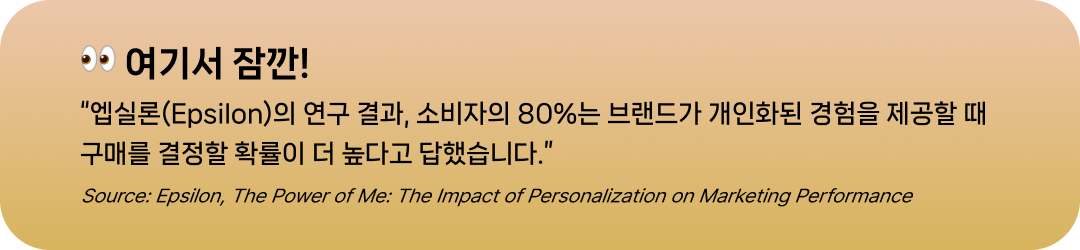
(Source=PLATEER)
AI can analyze vast amounts of data in real time, interpret customers' past behaviors and context, and predict future interests and behavioral patterns. For example, some customers seek emotional comfort by continuously listening to a specific genre of music, while others repeatedly visit a particular category within a shopping mall, contemplating a purchase. Recognizing this difference and not missing the moment when this shift occurs is precisely the decisive moment when a brand deeply embeds itself in the customer's mind.
While Spotify Wrapped aggregates a year's data to show ‘results,’ groobee reads customers' ‘current intent’ using real-time data.
If you're curious about how to create conversions with personalized experiences at the very moment customers hesitate,
In Part 2, we explore how to transform the trend of personalization into long-term loyalty, not just a one-time event.
✅Go to Part 2 [Click]
※ Source
Knowing Me Better Than I Do: The Era of Hyper-Personalized Marketing [Click]
The power of me: The impact of personalization on marketing performance [Click]
Did you like today's content?
Subscribe to the PLATEER newsletter!
We'll send you curated content from PLATEER right to your inbox.
15.jpg)


